Buyer’s guide · Updated 2026
Every remanufacturer says they’re the best. This guide gives you the seven things that actually separate a great remanufactured engine from a repainted used one — then shows you, point by point, why thousands of owners, repair shops and fleets answer that question with Fraser Engines & Transmissions.
How to judge any remanufacturer
Price is the last thing to compare. Check these first — and ask any seller to show you, not tell you.
A true remanufacturer owns the machining, assembly and testing. A broker takes your money and forwards the order — quality changes with every supplier.
Bare-block teardown, thermal cleaning, magnaflux, pressure test, CNC decking / boring / honing, ground crank. Anything less is a rebuild, not a reman.
Pistons, rings, bearings, timing components, gaskets and seals new. “Inspected and reused” is how the same failure comes back at 30,000 miles.
Every engine family has known weak points — lifters, phasers, chains, oiling. The best builders apply the OEM and aftermarket Technical Service Bulletin fixes before the engine ships.
Year / make / model is not enough. The engine code, emissions package and transmission pairing must be confirmed from the 17-digit VIN.
Multi-year, unlimited-mile, parts and labor, with claims handled by the builder — not a third-party administrator or a parts-only policy.
Years in business, verified reviews, BBB rating, PERA membership. A website is easy to launch; a reputation takes decades.
There can only be ONE champ
Know who you’re buying from
| Source | What you get | Warranty | Watch out for | Fraser |
|---|---|---|---|---|
| Used / salvage yard | Donor engine with unknown mileage and history | 30–90 days, parts only | Hidden wear, no updates, no fitment help | Zero-mile reman with new internals |
| Online engine broker | Whatever a third-party supplier ships | Administered by someone else | No quality control, chasing two companies on a claim, “no core” gimmicks | Built and warranted by the manufacturer |
| Local rebuilder | Your engine, repaired — scope varies by shop | Short-term, often labor excluded | Reused marginal parts, no TSB updates, one-person shop risk | 14-step process, all TSB updates, 60+ years |
| OEM new crate engine | A brand-new engine — when available | Typically 12–36 months | Highest cost, discontinued for most 5+ year-old vehicles, still has the original design flaws | Fraction of the cost, longer warranty, weak points corrected |
| National remanufacturer (Fraser) | Fully remanufactured, VIN-matched engine with published build content | 3–5 yr / unlimited miles, parts & labor, No-Fault options | Confirm the seller actually builds it — Fraser does | ✅ The best value for a vehicle you’re keeping |
Print this before you buy
Ask any seller these ten questions. If they can’t answer in writing, keep shopping.
Thousands in StockNot all Fraser engines are the same, either
Remanufactured block and heads, new pistons, rings, bearings, timing components, gaskets and seals. 3-Year / Unlimited-Mile parts & labor warranty.
Upgraded block, updated heads, new internals, oil pump and every OEM & aftermarket TSB update applied. 5-Year / Unlimited-Mile + 1 Year No-Fault FREE.
Fraser Advantage™ plus oil pan, timing cover, valve and valley covers installed — or DOD / AFM / MDS-delete and high-performance builds for specific applications.
Build content varies by engine family and SKU — each product page lists exactly what’s included. No-Fault upgrades ($99–$499) are available on any build. Learn more about the Fraser Advantage™ →
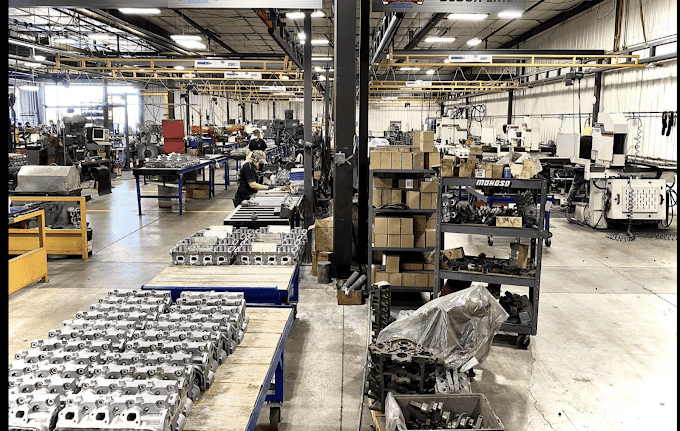
Inside the Fraser plant
Fraser is committed to delivering engines of exceptional quality and performance. Our rigorous, detailed process ensures every engine meets our high standards and exceeds your expectations.
A thorough visual inspection of each block for casting defects, meticulous disassembly with every part inspected for damage and the cause of failure identified. Oil and water passage plugs are removed to guarantee optimal results during thermal cleaning. Only premium castings are selected — never repaired castings or sleeved blocks on high-performance engines.
Our thermal cleaning system distributes heat evenly through the chamber, avoiding overheating or warping. Components are heated in an oxygen-deficient atmosphere that decomposes combustible hydrocarbons and leaves parts dry. The Ace RKE 230 oven is used exclusively for cast-iron blocks.
Stainless-steel shot removes surface contamination like rust for a smoother finish — vital for detecting surface and subsurface defects — while the peening process imparts compression strength to the metal.
Magnetic particle inspection detects cracks and imperfections in ferrous engine parts, ensuring the highest quality for our cast-iron blocks.
Aluminum blocks first go through the AXE SW20 OS spray cleaning system, whose multi-integrated nozzles remove all foreign material — crucial for a thorough inspection.
Ultrasonic cleaning — the benchmark in cleanliness — reaches inaccessible areas and breaks the bonds holding small particles to surfaces before pressure testing.
The Delta pressure tester double-checks for pinholes after magnafluxing and dye testing, ensuring the integrity of every casting used in our products.
After a complete visual inspection we repair minor casting defects, remove broken bolts, tap threads and perform gasket surface repairs to minimize stock removal.
The RMC CNC V40 enclosed machining center measures and levels blocks and measures deck heights and cylinder bore sizes, eliminating operator error. It determines the Ra finish based on block type and gasket, using CBN cutters and checking surface finish with the Mitutoyo SJ-301.
The Sunnen LBB-1600 hone, accurate to within .0001″, reconditions rods and fits pins so honed bores are equal to or better than new. High-performance engines get ARP high-strength bolts and nuts first.
Rottler’s newest cylinder honing machine finishes cylinders within .0001″ roundness and straightness, continuously analyzing and correcting the bore to hold the critical oil clearances modern engine designs demand.
After precise machining, every block undergoes a second high-pressure wash cycle for absolute cleanliness before final assembly.
All parts are ultrasonically cleaned prior to assembly, reaching every surface and internal area to meet the most stringent cleanliness standards.
Each assembler conducts a thorough visual inspection and measures parts for proper size. Blocks are fitted with new cam bearings, oil restrictors, relief valves and new water and oil plugs; heads are installed with new bolts and gaskets and each cylinder’s seal integrity is checked. A final inspection by our assembly manager signs off every engine.
The gold standard in engine remanufacturing
Dual-function boring and resurfacing with unrivaled accuracy — cylinders bored and honed to exact dimensions, blocks and heads resurfaced to precise specifications for a perfect head-gasket seal on every engine type.
Complete crank grinding in a single chucking — the fully automated precision typically exclusive to OEM plants — delivering stabilized dimensional accuracy, superior surface quality and tighter tolerances.
Operational since 2016, our flame spray machine applies cylinder-bore coatings with unmatched precision and uniformity, surpassing industry benchmarks for current-model-year engines and extending engine life.
See the best for your vehicle
23 remanufactured engine families →
32 remanufactured engine families →
25 remanufactured engine families →
5 remanufactured engine families →
6 remanufactured engine families →
2 remanufactured engine families →
9 remanufactured engine families →
Frequently asked questions
The best remanufactured engines come from companies that build them in-house with a complete teardown, CNC machining, all-new wear components, factory TSB updates, VIN-verified fitment and a multi-year parts-and-labor warranty they pay themselves. Fraser Engines & Transmissions — remanufacturing in Michigan since 1961 with a 4.8-star rating across 9,000+ reviews — meets every one of those standards.
A properly remanufactured engine is machined back to OEM specifications with new pistons, rings, bearings, timing components, gaskets and seals — and, on Fraser Advantage™ builds, the factory’s TSB fixes applied. In that sense it can be better than the original, because known design weak points are corrected. It also costs a fraction of a new crate engine and carries a longer warranty than most OEM crate programs.
Rebuilt usually means the failed parts were replaced and the rest reused, to standards that vary by shop. Remanufactured means the engine was completely disassembled, cleaned, inspected, machined and reassembled to a defined specification with new wear components — a zero-mile engine.
It depends entirely on who actually built the engine — and the broker often can’t tell you. Because a broker doesn’t control quality, build content or the warranty process, you’re buying an unknown. Buying direct from the remanufacturer removes that risk.
With proper installation, break-in and maintenance, a quality remanufactured engine should last as long as a new one — typically well over 100,000 miles. Fraser backs that with up to a 5-Year / Unlimited-Mile warranty plus No-Fault coverage.
At minimum, a multi-year, unlimited-mile warranty covering parts and labor. Fraser offers 3 years on Standard builds and 5 years plus 1 year of free No-Fault on Fraser Advantage™ builds, with No-Fault upgrades to 5 years and Premium Pay / Elite Maxx tiers that add towing and rental reimbursement.
Yes — Toyota / Lexus, Honda / Acura, Nissan / Infiniti, Kia / Hyundai and Subaru, in addition to Chrysler / Dodge / Jeep / RAM, Ford / Lincoln / Mercury and GM, plus diesel and high-performance engines.
Buy from the champ
Press 1 for Sales · Mon–Fri 8AM–5PM EST · Online ordering open 24/7 · sales@fraserengines.com